
1. PURPOSE OF THE GUIDELINES
- The design guidelines have been created to encourage and inspire homeowners to actively participate in the further development of their community. To personalize their living environment, to improve on the quality of their property, and most importantly, enjoy their investment at Bayside.
- They have been established to assure and implement the highest quality design standards for the community. They serve as a framework from which the Design Review Committee (DRC) will work to ensure the positive evolution of the community.
- They have been developed to complement the Declaration of Covenants, Conditions and Restrictions of Bayside and according to the responsibility assigned the DRC, to establish fair and equitable standards by which to review the planning and design of enhancements of the homes in the community.
- Where the Governing Documents require compliance with the Community Wide Standard, the standard to be applied is the highest of: (a) the standard of use, conduct, architecture, landscaping, or aesthetic matters generally prevailing in the Community, or (b) the minimum standards described in the Community Charter, the Design Guidelines and the Rules and Board resolutions. The Community Wide Standard may contain objective elements, such as specific maintenance requirements and subjective elements, such as matters subject to the Board’s or the DRC’s discretion. The Community Wide Standard may or may not be set out in writing (or as modified by the Board of Directors).
- Through these guidelines and design review process the DRC will seek to endeavor to protect your investment from less than desirable design solutions, maintain the integrity and appearance of your neighborhood and, with the participation of each homeowner, enhance the value of your community.
2. THE DESIGN REVIEW COMMITTEE
- In accordance with section 6.2(a) of the Community Charter, the Founder has exclusive authority to review and act upon all applications for review of proposed improvements until the later of (i) the expiration of the Development and Sales Period or (ii) such time as all homes planned for the property have been improved with dwellings for which a certificate of occupancy has been issued. The Founder may designate one or more persons to act on its behalf in reviewing all applications (or as modified by the Board of Directors). Upon the Founder’s delegation of authority under section 6.2(b):
- The DRC shall consist of at least three (3), but no more than five (5) members appointed by the Board of Directors and who:
- Shall serve and may be removed and replaced in the Board of Directors’ discretion. Representatives must be owners and may, but need not, include architects, engineers, or similar professionals.
- Primary responsibilities of the DRC are to:
- Assist the homeowners with the successful completion of improvement projects they seek to undertake.
- Evaluate each submission for adherence to the criteria and standards established in the Design Guidelines.
- Interpret the standards and intent of the Design Guidelines. Should conflicts arise from these interpretations the DRC will review, evaluate the conditions, and make final recommendations to the applicant.
- Grant variances from the Design Guidelines for unforeseen conditions providing that the applications adhere to the general intent of the Design Guidelines.
- Monitor and review the design and construction process to ensure conformance with the Design Guidelines and approved design. It is however the responsibility of the homeowner to ensure that the finished project is consistent with the approved plans.
- Review and respond to each submittal by providing comments and/or authorizing continuation into the next level of the review process. Unapproved submissions shall be revised and resubmitted for review and approval. Final approval shall in no way relieve the homeowner of his or her responsibility for the adherence to regulations, codes or ordinances of local, state, and other governing bodies having jurisdiction over Bayside.
3. THE REVIEW PROCESS
3.1. Design Submission:
- Prior to submission of a project, a site (“plat”) plan should be obtained and reviewed to ensure that the project being submitted adheres to both the building restriction and property set back lines. All lots have definitive building restriction lines (B.R.L.) which is a line fixed at a certain distance from the front, back and/or sides of a lot or at a certain distance from a road or street that marks the boundary of the area within which no part of any building may project. Furthermore, while unlikely, there is risk that any improvements could be disturbed to access any area within the 5ft. or 10ft. property specific, rear easement and the 5ft. side utility and/or drainage easement. All lots have set back lines which delineate the required distances for the location of a structure in relation to the perimeter of the property. The Design Guidelines and application can be found on the Bayside HOA website, TownSq. A completed application along with appropriate
application fees, design drawings and specifications are required for review and shall include the following:- Site plan indicating the improvements as well as the property line, existing building footprint, existing and proposed contours, and all easements, setbacks, and rights of way. Building plans, elevations, sections, and details that describe the improvements.
- Specifications outlining all materials and finishes for the
improvements. - Work not performed by the homeowner must be done by a licensed and bonded contractor. Copies of business license and certificate of insurance must accompany application.
- Quality of all documents must clearly describe and depict the work to be done
- Photo of the area to be considered.
3.2. Fees:
- A non-refundable application fee of $100 payable to Bayside HOA is required to accompany the application. See the Landscape Bed and Plantings section for landscape fee and/or application exceptions, specifically the Landscape Quick Reference Guide. A security deposit of $500 payable to Bayside Community Master HOA is required to accompany the application. Security deposit will be cashed and will be refunded after satisfactory inspection of completed project, approximately sixty (60) days following post project inspection approval.
3.3. The Design Review Committee:
- May consider factors relevant to the surrounding structures and environment as well as its interpretation of the Design Guidelines.
- Shall have sole discretion to make decisions on all matters of aesthetic judgments.
- Shall make its determination on each application within 30 days after receiving a completed application and required information. The applicant will be notified
within 7 days following the decision. - May approve or disapprove entirely an application or any portion it deems insufficient.
- May provide comments to the applicant indicating any deficiencies and/or suggested modifications to the proposal. Applications that have not been approved must be revised and resubmitted for review.
3.4. Design Modification (as required)
- Based upon the response from the DRC, the applicant may be required to revise their proposal and/or provide supplemental information to the DRC. The revised submission would then be resubmitted to the DRC for review and approval if all conditions have been met. New fees will not be required with a resubmission.
3.5. Appeals Process
- If after the completion of the above process, the homeowner and the DRC cannot come to an agreement, the homeowner has a right to appeal to the Board of Directors (as outlined below and in accordance with section 6.0 of The Charter).
- An applicant may appeal disapprovals of the application to the Board.
- An appeal must be submitted no later than 15 days after the delivery of the notification of disapproval.
- A copy of the original application, the notification of disapproval, and a letter requesting review of the decision must be included.
- The appeal request shall also contain a response to any specific concerns or reasons for disapproval, if any, listed in the notification of disapproval.
- Once an appeal has been presented to the Board, the Board can do one of the following:
- Affirm the DRC’s decision.
- Overturn the DRC’s decision.
- The Board shall notify the applicant and the DRC, in writing, of their decision within 30 days after its receipt of the request for appeal with all required information.
- During the appeals process, the Owner shall not commence any work requiring approval hereunder.
3.6 Building Permits
- Sussex County building permits, if required, will be the responsibility of the homeowner. Copies of all permits must be received and posted at the project site prior to the commencement of the start of the project.
3.7 Time Allocated to Complete Project
- All projects will have a time limit of one (1) year from approval of the DRC unless more is requested by the Homeowner.
3.8 Final Inspection
- After the improvement has been completed, Property Management should be notified. They will visit the site to inspect and verify that the improvements are consistent with the approved plan, and they are following the original documents.
- It is the homeowner’s responsibility to notify the Property Management that the project is ready for Final Inspection.
- Homeowner will have 30 days to fix all deficiencies and to call for another final inspection.
If deficiencies are not fixed, the property will be deemed non-compliant and subject to the Association’s enforcement policy.
4. Construction Procedures
4.1 Working Hours
- All construction activities and delivery shall be conducted between the hours of 8:00 AM and 6:00 PM. The working hours do not apply to the Developer or Builder, however, both entities must abide by State and County law.
4.2 Working Conditions
- Under no circumstances should any materials, equipment, washout pit, etc. for exterior modifications be stored in common areas within the Community, including but not limited to, common area clam shells, driveway aprons, sidewalks, streets, and sodded areas. All materials should be stored within the homeowner’s property limits. In the event there isn’t adequate space for all materials to be stored within a homeowner’s property limits, the homeowner may seek permission from the Association to store materials in designated common areas as designated by the Association. Any damages to the common areas caused by the homeowner’s contractor, will be the responsibility of the homeowner to repair and/or replace.
- All construction activities must be completed in a manner to prevent injury or offense to adjacent properties including noise, vibration, smoke, dust, toxic or noxious waste materials, orders, fire, or glare.
- All sites must be maintained in a clean, orderly manner. All debris and rubbish are to be contained and removed periodically from Bayside and disposed of in an approved waste disposal site. Any soil or debris left by the contractor on public streets must be cleaned immediately.
- Disposal of construction debris is prohibited in the community compactors and dumpsters. Homeowners are directly responsible for their contractors and are subject to violation sanctions if their contractors use the community compactors/dumpsters.
- No burning is allowed.
- Construction parking shall not impede traffic in any way.
- No washing of vehicles or equipment on any community street will be allowed.
- Contractors shall provide portable toilets on projects out of public view where a permanent toilet facility is not provided by the homeowner.
- No open radios or recordings are allowed.
- No contractor or product signs will be permitted on the worksite.
- Permits must be posed within the project site in the public rights of way.
- Homeowners are responsible for the containment of all erosion and sediment within their property.
4.3. Damages & Responsibility
- Any damage to community property, planting areas must be returned to the original condition by the responsible party. Repairs made by the HOA will be billed to the homeowner. All excavations shall require a marked utility survey.
5. Design Guidelines
5.1 General Considerations:
All site work, landscaping, structures, improvements, and other items placed on a Unit in a manner or location visible from outside of existing structures on the Unit are subject to these Design Guidelines and the approval procedures set forth in this document.
Property Line Encroachment-No structure (i.e., attached to the home and under a roof) shall be permitted to be constructed or installed which encroaches the property setback lines. Steps can extend into the property setback area but cannot extend within 5 ft. of the property line. There is a 5 ft. utility easement along every side property line. A 5 ft. or 10 ft. property specific easement is located along the rear property line. A utility survey by all appropriate utility company providers must be obtained by an owner whose project potentially encroaches this utility easement.
Careful consideration will be given to your improvements, so they will impact favorably on your neighbors and the neighborhood.
The DRC will consider the following issues when evaluating your planned improvements.
- Consistency in neighborhood
- Sunlight, ventilation, drainage, and privacy of your neighbor
The DRC will consider several elements listed below and the impact they will have on your home and neighborhood.
- MASS: It affects the visual relationship with a given context, between adjacent structures and the preservation of views
- PROPORTION: It establishes a dimensional relationship of and between elements
- COLORS: Appropriate use
- MATERIALS: Must be in harmony with the community
The Design Guidelines were developed to encompass all anticipated exterior modification requests. On occasion a specific reference may be unintentionally omitted but this does not constitute approval or disapproval. The homeowner must submit an exterior modification application for review which will be to the discretion of the DRC to ensure the application adheres to the general intent of the Design Guidelines, Community Wide Standards and Community Charter.
5.2 Arbors, Gazebos, Trellis & Pergola
Arbors, Gazebos, and Trellis are not permitted.
Pergolas are allowed in rear yard only. Pergola design must be incorporated into paver patio design, using white composite material only. No cloth or material can be placed on or within the pergola structure. DRC approvals will be on a case-by-case basis depending on style of home and location of home. Pergolas are permitted on single family, duplex, twin, or villa home product.
5.3 Awnings & Porch Shades
Retractable awnings are permitted on first floor rear decks or patios. Stationary awnings are not permitted. Awnings may be attached to siding or soffit only; they may not be attached to roof shingles. The framework and housing unit must be white and awning material must be a “Sunbrella” type material or similar in quality and durability.
Awning color must be neutral and complementary to siding color. Solid or stripe in beige, grey, blue, green, or burgundy may be acceptable. Please submit at least 3 choices, in order of preference, with application for final DRC approval. The first homeowner on a duplex, twin or villa home product will set the color palette for the neighboring home. When not in use or when property is unoccupied, awnings must be completely retracted to minimize potential damage, for which owner bears full responsibility. All fabrics and frameworks must be maintained in good working order and appearance always. Owner is responsible for replacement or removal of awnings that are ripped, faded, or not in good working order.
DRC approvals will be on a case-by-case basis depending on style of home and location of home. Awnings are permitted on single family, duplex, twin, or villa home product.
5.4 Clotheslines
Not Permitted.
5.5 Decks
All decks must be in the rear of property. Design and detailing of first and second floor decks must be architecturally compatible and consistent with the home elements and community standards.
Decks must be built with composite decking. Painting of decks is not permitted.
Railing, balusters, and posts must be covered in white vinyl to match the community standard. However, stainless steel cable railings will be permitted on Single Family home rear decks only but must be spaced 3 ½” apart and no more than 48” post to post. All cable railings must be horizontal. If cable railings are installed, both the 1st floor, 2nd, and 3rd floor decks, if applicable, must maintain a uniform design. The space under decks must be concealed with maintenance free lattice or composite materials consistent with the neighborhood.
Enclosure of rear decks are permitted on single family and town homes only. Enclosed decks must be glass or screen and consistent with the architectural design of the home. Glass must go to the floor of the deck. Kick panels are not allowed.
Staircases should be white and complimentary to the home in style and materials. All staircases must be installed in the rear and integrated into the deck, porch and/or patio design. Any variation will be considered on a case-by-case basis.
The deck and stairs may extend a maximum of 5ft into the setback area (beyond the building restriction line) but a 5ft setback must be maintained from the side and rear property line. Please note that while unlikely, there is a risk that any improvements could be disturbed to access any area within the 5ft. or 10ft. property specific, rear easement and the 5ft side utility and/or drainage easement. Any disturbance to improvements will be at owner’s expense.
* The Design Review Committee retains the right to deny or alter any plans which encroach into any easement area. The HOA retains the right to maintain any drainage areas within 5 ft of the property line to maintain adequate drainage and that the property owner will be responsible for any maintenance required by the HOA due to alterations by the owner.
5.6 Decorative Objects, Flowerpots & Lawn Ornaments
Decorative objects on the residence’s exterior (front – sides – rear) shall not detract from the character of the Community and in all cases must be consistent with the degree and appropriateness that is prevalent throughout the Community (the Community Wide Standard). Size, number, location, color and compatibility with architectural and environmental design qualities and visual impact on the surrounding area will be reviewed. By way of general guidance on exterior decorations:
All exterior lawn decorative objects must be in mulch beds and are not permitted on any grass areas. Decorative objects shall not be larger than 3’ high, 2’ wide and 2’ deep. Front door, entryway, balcony areas as well as rear deck and patio decorations/furniture must be consistent with character of community, home style and color. Any front or rear of home ornamental features and yard artwork should not exceed 30”.
All exterior hanging baskets and pots with flowers must always be appropriate in size, aesthetically pleasing and compliment the exterior of the home. Chains from hanging baskets must be removed if not in use.
Only one (1) bird bath (36” high x 30” in diameter or smaller) in concrete gray, earth tone or metal and two (2) bird feeders (12” x 12” x 18” or smaller with a holder not to exceed 60” in height) are permitted in the rear yard and must be incorporated into a landscape bed.
Temporary holiday decorations are permitted and may be displayed thirty (30) days prior to the holiday and must be removed within fifteen (15) days following.
A DRC application is not required for decorative objects, flowerpots, and lawn ornaments.
5.7 Dog Houses
Not permitted.
5.8 Doors, Storm Doors, Screen Doors & Garage Doors
New or replacement doors shall match existing doors in style and color consistent with approved color palette. Homeowners may paint their front doors black or white without submitting an application.
Front door decorations are permitted but must not be offensive.
Storm and screen door must be full view, white or color to match existing door. Storm doors are permitted on all homes, including townhomes.
Changing garage doors, both color and/or materials will be considered on a case-by-case basis.
5.9 Driveways
- SINGLE FAMILY: Driveway borders for single family homes may be added along the driveway with a 12” – 24” width on both sides, using a 6”x9” paver in gray or earth tone to coordinate with foundation color of the home and/or existing lead or walkway paver of the home. Paver driveways may be installed up to the inside line of the sidewalk, and no wider than the current driveway footprint and/or existing driveway border, on a 9” or greater compact base. Pavers shall be 6” x 9” stone or concrete. Paver color must match the existing paver apron or be gray or earth tone to coordinate with the foundation color of the home, and/or existing lead or walkway of the home. Design and detailing must be architecturally compatible with the home.
- TOWNHOME/VILLA: Driveway borders for Townhomes or Villas homes may be added along the driveway with a 12” – 24” width on both sides, using a 6”x9” paver in gray or earth tone to coordinate with foundation color of the home and/or existing lead or walkway paver of the home. Paver driveways may be installed up to the inside line of the sidewalk, and no wider than the current driveway footprint and/or existing driveway border, on a 9” or greater compact base. Pavers shall be 6” x 9” stone or concrete. Paver color must match the existing paver apron or be gray or earth tone to coordinate with the foundation color of the home, and/or existing lead or walkway of the home. Design and detailing must be architecturally compatible with the home. Townhomes and Villas are also permitted to alter driveway median, with written neighboring consent. The driveway median must be compatible with driveway paver border, if applicable, or landscape material such as 1–3-inch Delaware blend river rock or clam shells but must be consistent with the neighborhood as defined in the “Landscape Plantings” section. Mulch in median is not permitted. The owners on both sides will be responsible for the shared maintenance costs.
5.10 Encroachment
Modifications to common ground and naturalized areas are prohibited. Modifications include trimming and removing plants and trees and hardscape installation. Yard debris and holiday decorations, such as pumpkins and holidays trees, must be disposed of properly rather than discarded in naturalized areas.
5.11 Exterior Lighting Fixtures
Replacement of like-kind exterior lighting fixtures are allowed with same color, finish as existing/original lighting fixture.
5.12 Fencing
Fences are permitted in select rear yards only, may not extend into front or side yard.
- Grand Estates Homes (Lots 90A, 90B, 91-100)
- Eastpoint Beach Homes (Lots 1000-1012, 1035-1043, 1013-1021, 1044-1047)
- North Haven Homes (Lots 3200-3299)
- Coastal Crossing (lots 734-737, 748-766)
Fencing must be black aluminum and consistent with other Bayside fencing, may not exceed 48” in height and must include a 60” swing gate.
Invisible electrical fencing is permissible for single family, townhomes and villas, backyard installation only.
Owner will be responsible for any/all repairs needed.
5.13 Fire Pits & Fireplaces
Fire pits may be permitted if they are in the rear of the property, are no more than 20″in height and 50″ in width, incorporated within a patio design and fueled by propane only. Fire features may be permitted if they are in the rear of the property, are no more than 28” in height, fueled by propane and incorporated within a patio/wall design. Fire features exceeding 28” in height will be considered on a case-by-case basis.
Chimineas, wood burning fireplaces, fire rings and other incendiary devices are prohibited.
No wood burning is permitted.
5.14 Flags, Flag Buntings & Flag Poles
Owners shall have the right to display at any one time, one (1) United States flag or one (1) appropriate seasonal or sport theme flag, measuring up to three (3) feet by five (5) feet, on a pole attached to the exterior wall of the Unit. Flag buntings measuring up to three (3) feet by five (5) feet may only be attached to the front or rear railings of a deck or balcony.
A maximum of two (2) garden flags, not to exceed 12” x 18” for the flag itself and 36” in height for the holder, are permitted. The garden flags must have appropriate American, seasonal, or sport theme. Seasonal or holiday flags and buntings must be removed within fifteen (15) days of such holiday.
Free-standing flagpoles are not permitted. A DRC application is not required for flags.
5.15 Fountains, Water Features & Ponds
Ponds are not permitted.
Free standing foundations and water features are not permitted.
Water features including fountains may be permitted only within a paver patio, must not exceed 28” in height and must be integrated within patio walls. Water features and fountains exceeding 28” in height will be considered on a case-by-case basis. All electrical and plumbing components must be concealed.
5.16 Grading & Drainage
All grading modifications must ensure positive drainage away from the buildings. Existing grade must remain at all points along property line. During grading construction, measures must be taken to avoid erosion and offsite sedimentation.
5.17 House Numbers
Shall be of the same size, color, style, and location of original numbers.
A DRC application is not required to replace house numbers.
5.18 Hurricane Shutters
White hurricane shutters are permitted on Single Family and Townhomes only.
Hurricane shutters are encouraged for use only during storm events, in the off-season and may not be visible when not in use.
5.19 Irrigation
Proper installation and/or relocation of irrigation is required. The applicant and any/all contractors will be held responsible for the structural integrity of the irrigation system. In addition, applicant and any/all contractors are responsible for any disruptions, failures, and/or damages that may occur at any time in the future as a result of the construction and change to the irrigation system, not only to the property but also, to any surrounding properties and common ground. This would include any sprinkler heads and subsequent lines presently on the property that require relocation to accommodate the project.
5.20 Landscape Beds and Plantings
A DRC application must be submitted for any/all landscaping addition, modification, or alterations for all homes. To achieve and maintain overall uniformity within the community and neighborhoods, all owners must replace, modify, and add plant and mulch material from the Community Plant List referenced in Appendix A. All trees and plants must be installed within a landscape bed. All trees and plants maturity size should be taken into consideration of landscape design and proximity of neighboring home. All irrigation modifications or additions must be noted within the DRC application.
Specific to landscape beds, the material used must conform to the following neighborhood standards.
The Commons, The Shoals and Homes along Signature Blvd must have brown wood mulch but may incorporate 1–3-inch Delaware Blend River Rock used as accents within the landscape beds.
Heron’s Ridge, Sun Ridge Crest, Old Postal Way, North Haven, Sea Grass Bend, Coastal Crossing, Captain’s Cove, Magnolia Crossing, East Point Beach, Harbor Crest and Harbor’s Edge must have brown wood mulch but may incorporate clam shell and/or 1–3-inch Delaware Blend as accents within the landscape beds.
If plant material or sod dies, the owner of the home is responsible to remove and replace the dead species and/or sod with the same or similar and an application is not required.
Stepping stones are permitted within a landscape bed.
In some instances, landscape screening may be required by the DRC for exterior modification improvements impacting the street view or view from a neighboring home such as hot tubs, pools, patios, etc. To better define plants that are acceptable for screening please refer to the following list:
- Arborvitae
- Crape Myrtle
- Holly
- Nandina
- Privet
- Skip Laurel
- Viburnum
- Pines: Australian, Black & White
- Atlantic White Cedar
- Hollywood Juniper
The above list is not intended to be all inclusive but rather a guide. The DRC may approve alternative screening plant material at their sole discretion, at the request of a homeowner.
Landscape Quick Reference Guide
Application Required | Fee Required | |
Replace exact plant/sod | No | No |
Replace or add plants from approved list or like for like | No | No |
Remove a plant | Yes | No |
Add , expand, minimize and/or remove landscape bed | Yes | Yes |
Add annual flowers/plants | No | No |
5.21 Lead Walks & Walkways
Front lead walks and/or side/rear walkways must be architecturally compatible with the home and community standard. Material must be 6” x 6” or 6” x 9” pavers in natural stone or high strength compressed concrete with a minimum thickness of 2 & 1/8th inch. Lead walks and walkways shall be installed per manufacturer’s recommendation with a minimum 4” compacted gravel base set upon firm, compacted stable earth sub-base. Pavers shall be set in 1-2” setting sand or stone dust and joints filled with polymeric or jointing sand. Colors shall be earth tone to compliment the surroundings and aesthetic of the home.
Side or rear walkways shall not exceed 48” in width. Side or rear walkways requests exceeding 48” in width will be considered on a case-by-case basis. The DRC may grant walkways exceeding 48”, only if the overall layout enhances the appearance and uniformity of the property due to hindrances such as trash enclosures and/or HVAC units, as well as potential areas where small voids may be created if left unhardscaped and may also create a maintenance issue.
Steppingstones are not permitted as a lead walkway and are only to be used in rear and side yards behind the plane of the home’s front wall. Steppingstones shall be made of concrete or natural stone with a thickness of 2” or less and set in a mulch bed in a continuous row or one step apart. Colors shall be earth tone to compliment the surrounding and aesthetics of the home.
5.22 Lighting
Motion Detector lights are permitted on the rear of the home for security purposes only. Flood lights, spotlighting of the dwelling and lights mounted to trees are not permitted. Landscape lighting along driveways, front yard paths and landscape beds are permitted but must not exceed 1’ in height. All conduits and wiring must be concealed.
Aerial lighting, such as market lights, may only be installed over decks, patios and under porches or balconies. The lights must be soft white and illuminated only when the area is in use. All cords and wiring must be concealed in conduit or otherwise installed out of view.
Supporting posts should be covered in white vinyl and integrated into the deck and/or patio design. The lighting may only be installed one story above the walking area of the deck or patio. Aerial lighting should be turned off at 11:00 pm, coinciding with the “quiet time” policy of the community. Holiday lighting is permitted thirty days prior to and fifteen days after said holiday.
5.23 Outside Showers
Outdoor showers are permitted on the rear and side of single-family homes and on a case-by-case basis for townhomes. Material, design, and color must match the existing style of the house. Enclosures must be installed on a concrete slab or paver pad.
5.24 Painting
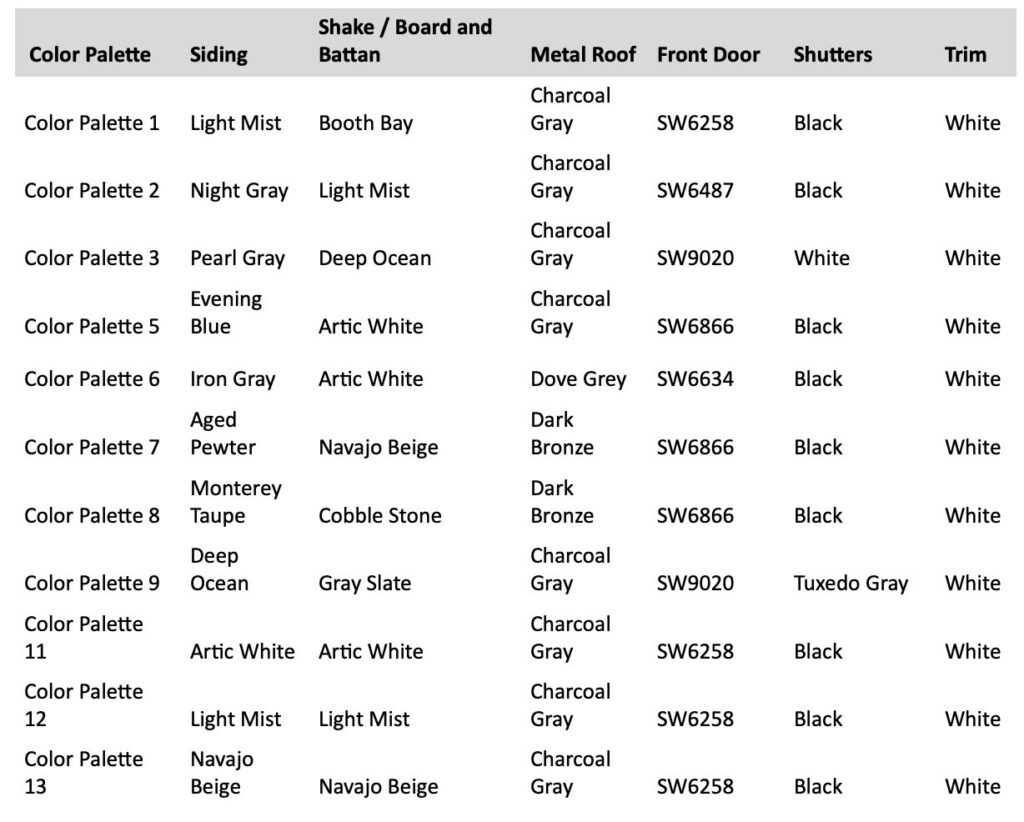
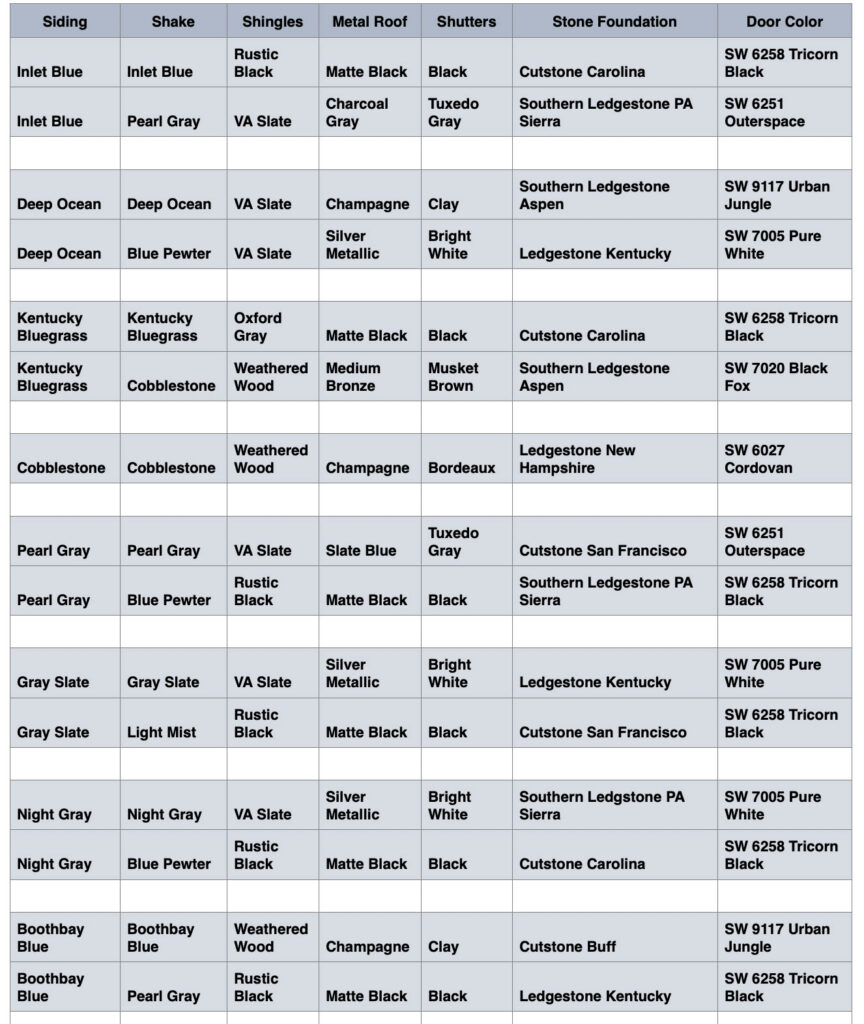
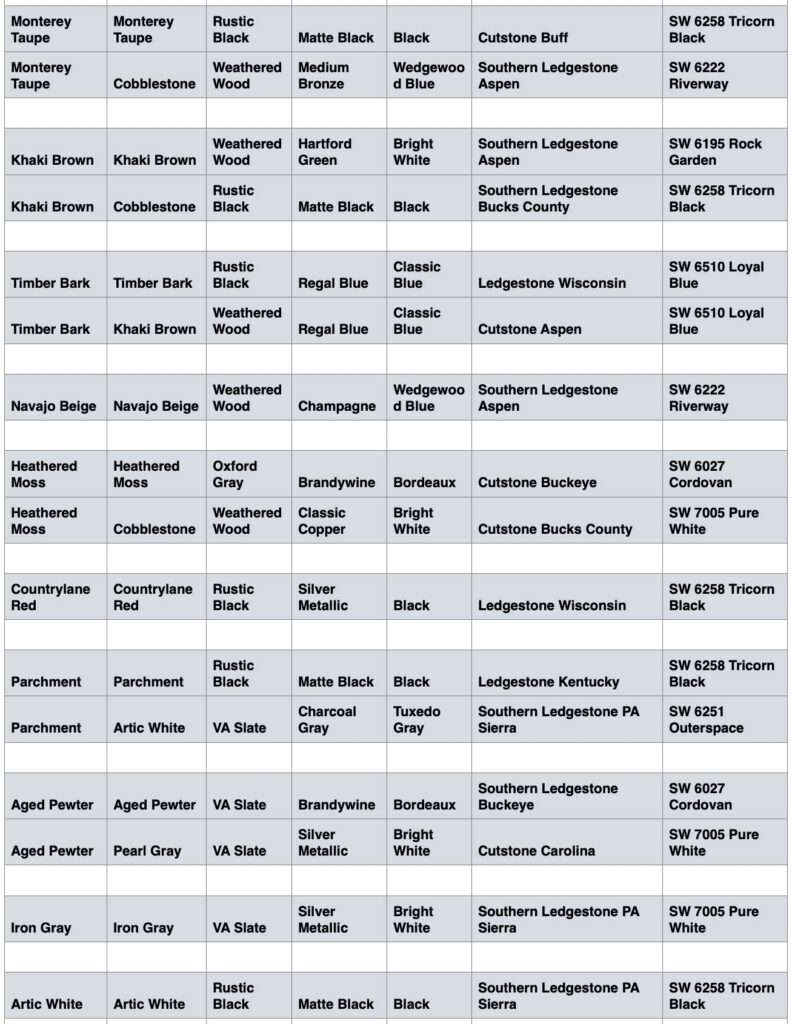
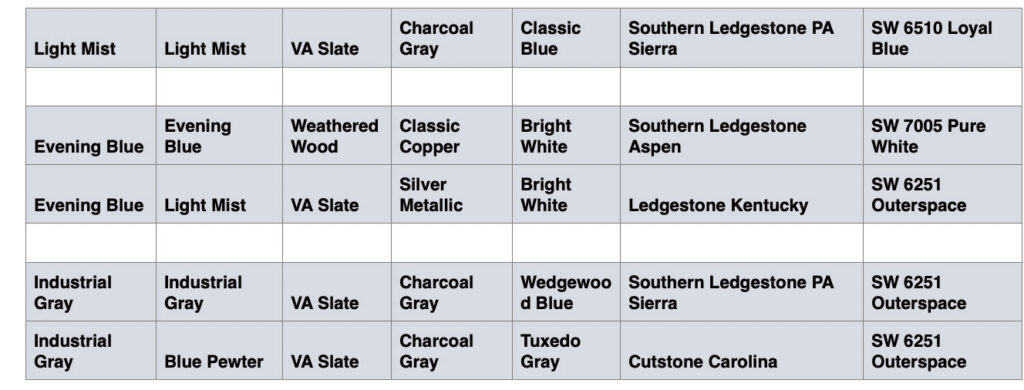
A DRC application is not required for repainting the exterior of the home to match existing colors. A DRC application and approval are required for any change to existing exterior colors. The application shall include a description of all existing exterior colors of the dwelling and a description of proposed paint colors for the siding, trim, shutters, doors and must follow the approved Builder color palette. Color palette and specific paint colors are subject to change. Please refer to Appendix B for Builder color palette options.
5.25 Patios
All patios must be in the rear of the property unless the lot is unique, such as lot configuration and/or home product where a rear patio may not be feasible. Therefore, all side patios will be considered on a case-by-case basis and landscape screening may be required if approved by the DRC. Design and detailing of patios must be architecturally compatible with the home, installed at grade or ground level, and may be installed up to the property line.
Patios must be installed with brick or pavers. The patio color must be earth tone or gray paver. Red brick patios will only be allowed on homes with existing brick foundation.
Patio walls cannot be greater than 28″ from inside finished floor of patio except for walls intended to house grills which cannot exceed 50” from the inside finished floor. Outdoor kitchens, countertops, and bars are permitted but, will be approved on a case-by-case basis and shall be integrated into the patio design and follow industry height standards. All columns must be incorporated into the patio design and will be considered on a case-by-case basis.
All flower boxes made of brick or paver materials must be incorporated into the patio design and will be considered on a case-by-case basis. Proper drainage must always be maintained and cannot be blocked by landscape and patio improvements.
Please note that while unlikely, there is a risk that any improvements could be disturbed to access any area within the 5ft. or 10ft. property specific, rear easement and the 5ft side utility and/ or drainage easement.
Any disturbance to improvements will be at owner’s expense.
* The Design Review Committee retains the right to deny or alter any plans which encroach into any easement area. The HOA retains the right to maintain any drainage areas within 5 ft of the property line to maintain adequate drainage and that the property owner will be responsible for any maintenance required by the HOA due to alterations by the owner.
5.26 Play & Sports Equipment
Not permitted.
5.27 Pools, Spas and/or Hot Tubs
Pools permitted in select rear yards only.
- On perimeter homes in Eastpoint Beach (lots 1000-1012, 1035-1043, 1013-1021 and 1044-1047)
- Grand Estate (lots 90A, 90B, 91-100)
- North Haven (lots 3200-3299)
- Coastal Crossing (lots 734-737, 748-766)
DRC will have sole discretion on approvals and denials for all pool designs submitted. All pool and spa/hot tub applications will be reviewed on an individual basis and will consider lot size, home type, professional integrated design, layout, location, and landscaping screening. All pools and spas/hot tubs must meet state and local code requirements and must be integrated into overall patio and/or deck design. A perimeter fence surrounding the pool must be incorporated as per state and local code requirements. No diving boards or slides will be permitted. Concealing pool equipment is strongly recommended. All pool equipment enclosures will be considered on a case-by-case basis.
All hot tub/spas must have treatment to minimize visual impacts to adjacent property owners. Acceptable treatment generally described as; semi or fully recessing hot tub/spa into the deck and/or patio, concealing wall, knee wall, and/or landscape screening to fully shield the hot tub/spa from plain view. All architectural and/or landscape treatment to blend with home material and design. Hot tub/spa to be in rear yard only. Proper maintenance and replacement of hot tub cover must be followed.
5.28 Porches
FRONT:
The deck and stairs may extend a maximum of 5ft into the setback area (beyond the building restriction line) but a 5ft setback must be maintained from the side and rear property line. Please note that while unlikely, there is a risk that any improvements could be disturbed to access any area within the 5ft. or 10ft. property specific, rear easement and the 5ft side utility and/or drainage easement. Any disturbance to improvements will be at owner’s expense.
REAR:
Rear porch design and detailing must be architecturally compatible and consistent with the home elements and community standards.
Porches must be built with composite decking. Painting of porches is not permitted.
Railing, balusters, and posts must be covered in white vinyl to match the community standard. However, stainless steel cable railings will be permitted on Single Family home rear porches only and must be spaced 3 ½” apart and no more than 48” post to post. All cable railings must be horizontal. If cable railings are installed, both the 1st floor, 2nd floor, and 3rd floor porches, if applicable, must maintain a uniform design. The space under porches must be concealed with lattice consistent with the neighborhood.
Enclosure of rear porches is permitted on single-family and townhomes only. Enclosed porches must be glass or screen and consistent with the architectural design of the home. Glass must go to the floor of the porch. Kick panels are not allowed.
Staircases should be white and complementary to the home in style and materials. All staircases must be installed in the rear and integrated into the deck, porch and/or patio design. Any variation will be considered on a case-by-case basis.
The porch and stairs may extend a maximum of 5ft into the setback area (beyond the building restriction line) but a 5ft setback must be maintained from the side and rear property line. Please note that while unlikely, there is a risk that any improvements could be disturbed to access any area within the 5ft. or 10ft. property specific, rear easement and the 5ft side utility and/or drainage easement. Any disturbance to improvements will be at owner’s expense.
* The Design Review Committee retains the right to deny or alter any plans which encroach into any easement area. The HOA retains the right to maintain any drainage areas within 5 ft of the property line to maintain adequate drainage and that the property owner will be responsible for any maintenance required by the HOA due to alterations by the owner.
SIDE:
Side porches will be reviewed by the DRC on a case-by-case basis and dependent on home design.
5.29 Major Roof Repair & Roof Replacement – All Home Types
All roofs should be maintained to meet the Community Wide Standard and always uphold a visually appealing appearance. Roofs for all home types (single family. townhomes, twin/villa homes) shall be kept free of debris. Shingles, flashing, and metal accents should be intact and free of deterioration, buckling, or fading. Routine maintenance including but not limited to roof cleaning and minor roof repairs will not require an application. Minor repairs are generally defined as miscellaneous shingle replacement or patchwork involving less than 10% of the roof surface.
An application is required for all major roof repairs and total roof replacements. Any variation in material, style, or color will be approved on a case-by-case basis depending on home design and location of home. Due to the unique aspects of roof replacements, a special application form has been developed. The roof application package is available within the TownSq document folder titled ‘Roof Repair and Replacement Application’. Application documents may also be obtained at the Bayside HOA management office.
Townhome Cluster and Villa Homes
Owners are strongly encouraged to replace their roofs concurrently using the same roofing contractor to ensure a consistent installation that would provide the uniform look and feel that is standard across the Bayside Community; as well as to preserve product and installer warranties (critical for the long-term protection of all Units).
All Unit Owners Agree to Re-roof Concurrently with One Roofing Contractor/Installer:
If the homeowners of a Villa or Townhome Cluster (townhomes with 3 or more Units) desire to replace their roof(s) at the same time using a single contractor, a SINGLE application must be submitted as one single package for the Villa or Townhome Cluster. Replacement of conjoined roofs that are submitted as a single application require:
- A signature of each Owner within the townhome Villa or Townhome Cluster should be collected on Roofing Application Form # 1-B. If a homeowner is unable to sign off on this form, they should send an email to the HOA Management Team to confirm their consent to re-roof their Units concurrently through a single contractor. When submitting the application, it is understood that each Unit Owner within the Villa or Townhome Cluster have agreed to their respective scope of work and financial obligation, pursuant to the agreement established with the roofing contractor and each Owner.
- SINGLE $100 application fee payable to Bayside Community Master Assoc.
- Each individual home is required to submit a $500 security deposit (each Unit Owner providing a separate check payable to Bayside Community Master Assoc) due to the possibility of damages that may occur during replacement. Deposits may be withheld if the project results in damages to the common areas or neighboring properties.
All Unit Owners noted on the application will be notified of approval or follow up items/questions.
Not All Unit Owners Agree to Re-Roof Concurrently
- The HOA will send a notification letter to any attached units within the cluster that are not included in the application package; providing those homeowners a final, formal opportunity to include their unit in the application package.
- Each Townhome owner will be required to submit a separate application along with the application fee and security deposit.
- It is important to note that any claims arising from future problems because the roofs were not replaced concurrently are the responsibility between the Owners of the affected Villa or Townhome Cluster. The HOA bears no obligation to resolve or incur liability to cure the disputed issues.
All roofs should be replaced with similar style and color of original home roofing material, including but not limited to shingles, and metal accents. All submitted applications and attending quotes must meet the requirements outlined in Appendix C Roof Component Description. If any application does not meet the requirements noted in Appendix C, then documentation should be provided outlining requested variances along with supporting documentation, from the selected roofing professional/contractor, of the reason(s) for the variance.
5.30 Satellite Dishes
Satellite dishes are permitted in accordance with FCC Rule 47 CFR.
The preferred location is below the peak of the roofline on the backplane of the house to have no visibility from the front of the house.
The Application Fee will be waived for all ‘Satellite Dish’ applications.
5.31 Shutters
Replacement of same style, color of existing/original shutters is allowed. Any modifications will be reviewed by the DRC and approved on a case-by-case basis.
5.32 Signage
Except as noted below, all signs visible from outside a residence are prohibited. This includes, but is not limited to, posters, circulars, billboards, or signs advertising businesses, sales, or leases. The exceptions to this are as follows:
- Signs required by law.
- An “Open House” sign may be posted for a period not to exceed three (3) days.
- One (1) sign, not exceeding 18” X 24”, containing political or similar endorsements, may be posted on a residence for a period not to exceed state and local law or ordinances.
- One security sign, not exceeding 12” in height, may be displayed in a private property planting bed or attached to the home.
- Up to two (2) signs, each not exceeding 10” X 14”, may be placed inconspicuously (i.e., not visible from the street) in planting beds to prohibit actions of or provide information to landscaping workers. For example: “Do not trim trees”.
A DRC application is not required for signage.
5.33 Skylights
Not permitted.
5.34 Solar Panels
Panels, frames, and hardware must be black and mounted to roof only. Panels to be installed on non-street facing roofs when possible. Detailed drawing of panel placement must be included with application.
5.35 Storage on Porches, Patios & Decks
The storage of furniture, grills and bikes is only permitted on rear porches, decks, and patios. Grill and custom furniture covers are acceptable. Items being stored are not allowed to be wrapped in plastic or tarp-like materials. In the off-season, flower plots should be stored out of sight; if possible, or at a minimum kept in an orderly manner free of dead plant material.
A DRC application is not required for storage on porches, patios, and decks.
5.36 Trash Enclosures
Design, color, material, and trim must match the exterior of the home. Enclosure is not to exceed 4′ x 7′ and should be attached to the side or rear of home with minimal visual impacts to streetscape and neighboring homes. The trash enclosure must have a hinged door for totes to be placed inside. Enclosure must be installed on a concrete slab or paver pad and must be elevated 1 – 2 inches from that surface to allow for drainage and ease for grass/weed maintenance.
5.37 Views
The DRC does not guarantee “views”.
5.38 Weathervanes
Not permitted unless installed at the time of original home construction. Replacement weathervanes must be like for like and any modifications or replacement will be reviewed by the DRC and approved on a case-by-case basis.
5.39 Window Air Conditioners & Fans
Not Permitted.
5.40 Windows
New windows must conform to existing windows and match in color proportion and overall composition with existing building.
Black/Bronze framed windows are permitted.
Replacement glass shall match existing glass and grill patterns.
Interior window treatments must be a white, off white, or light toned natural wood when viewed from the street.
Covering of windows with any material such as paper, newspapers, plastic, etc. is prohibited. Specific to windows within enclosed porches, see “Porches” section.
APPENDIX A-BAYSIDE COMMUNITY PLANT MATERIAL LIST
(Trees, Shrubs, Plants, Grasses, Etc.)
Disclaimer – The below approved list may not be inclusive of all plants allowed within the Community.
- Abelia
- Acer i.e., October Glory Red Maple
- Acuba
- Adam’s Needle Yucca
- Atlantic White Cedar
- American Beautyberry
- American Holly
- Amelanchier Serviceberry
- Austrian Pine
- Azalea
- Barberry, Crimson Pygmy
- Bayberry
- Beach Plum
- Birch
- Black Pine/Loblolly Pine
- Black Tupelo
- Boxwood
- Carpinus Hornbeams
- Callicarpa Beauty Berry
- Cercis Redbuds
- Chinese Hollies i.e., China Girl, BluePrince, Burford
- Clethra
- Crape Myrtles (All Types)
- Cryptomeria
- Dogwoods
- Downy / Shadblow Serviceberry
- Eastern Red Cedar
- English Hollies
- Fothergilla
- Fraxinus Ash
- Gleditisia Honeylocust
- Green Giant Arborvitae/Emerald Green Arborvitae
- Green Vase, Village Green Zelkovas
- Goldthread Cypress
- Golden Gem
- Highbush/Lowbush Blueberry
- Hollywood Juniper/Cedars
- Hypericum
- Hydrangea (All Types)
- Indian Hawthorne
- Inkberry
- Itea (All Types)
- Japanese White Pine
- Koelreuteria Goldenrain Tree
- Ligustrum (All Types)
- Liriope
- Little Blustem
- London Plane Tree
- Mexican Feather/Northwind Panic Grass
- Mugo Pine
- Nandina
- Nearly Wild Rose
- Nellie Stevens/Red Hybrid/Oak Leaf/Foster’s
- Prairie Dropseed
- Pitch Pine
- Pumilo Mugo/Thunderhead Black/Dwarf Mugo Pine
- Red/Sugar / Trident Maple
- Redtwig Dogwood
- Roses (All Colors)
- Sea Oats
- Shrubby Cinquefoil
- Southern Magnolia/ ‘Little Gem’/Edith Bogue/Sweet Bay
- Spireas
- Sweetgum
- Sweetfarm
- Sweetbay Magnolia
- Taxodium Bald Cypress
- Ternastroemia
- Viburnum (All Types)
- Vitex
- Willow, White, Red, Pin Oaks/ Drake
- Yaupon Holly
FLOWERS: Annual and perennial flowers are also permitted but should be consistent with the theme of the community and properly maintained.
APPENDIX B - BUILDER COLOR PALETTES
FREEMAN EXTERIOR COLOR PACKAGES
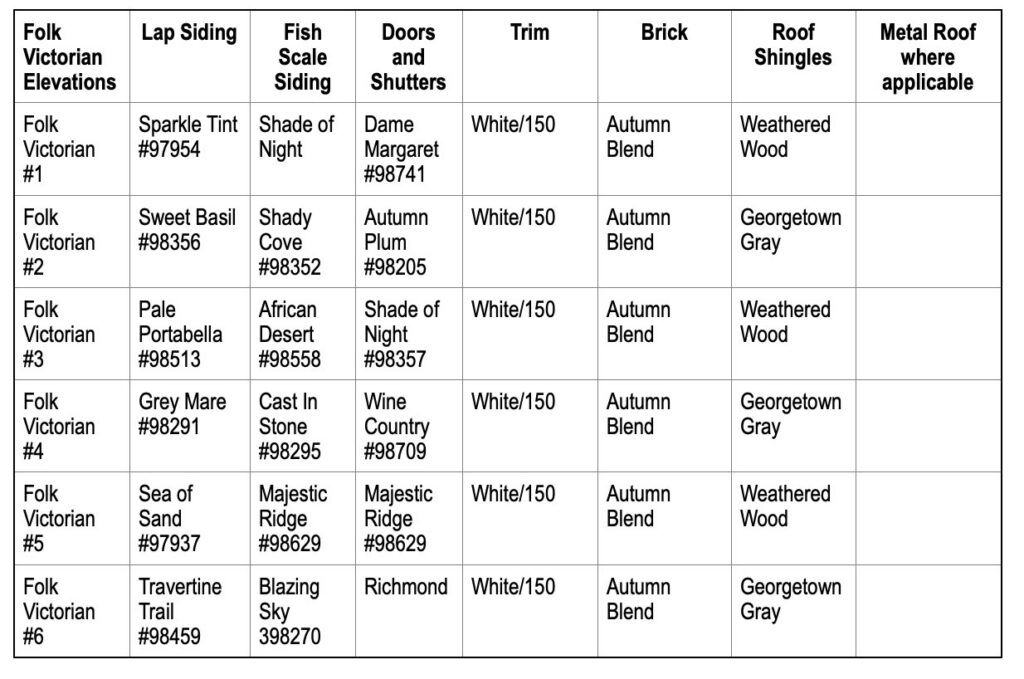
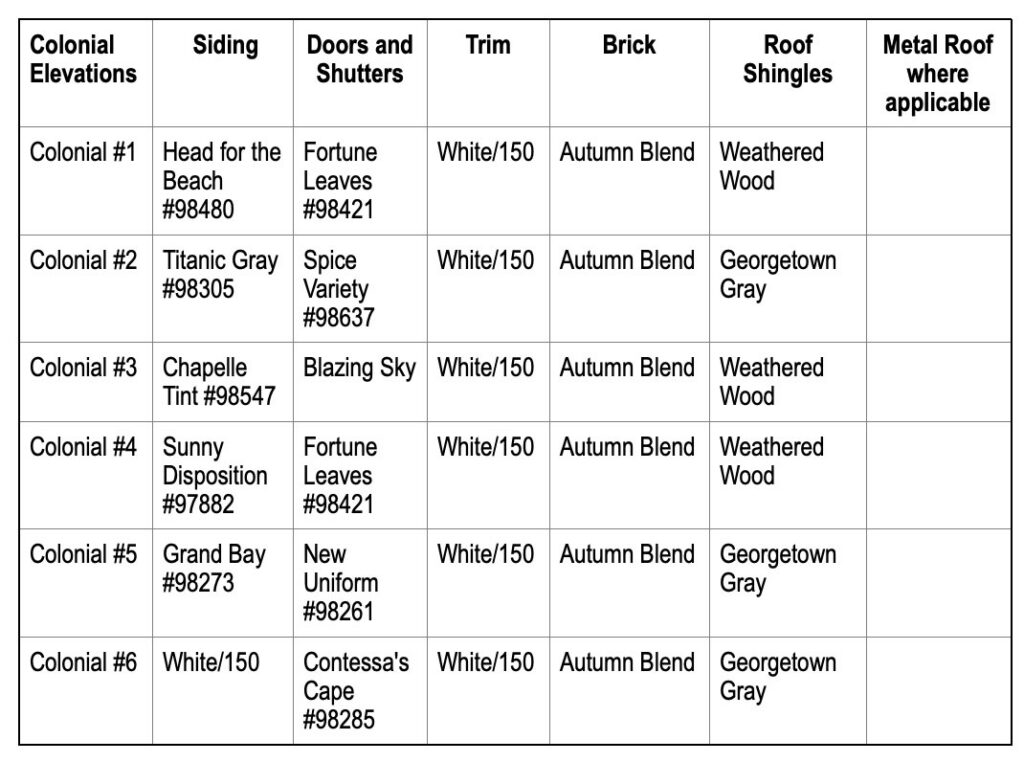
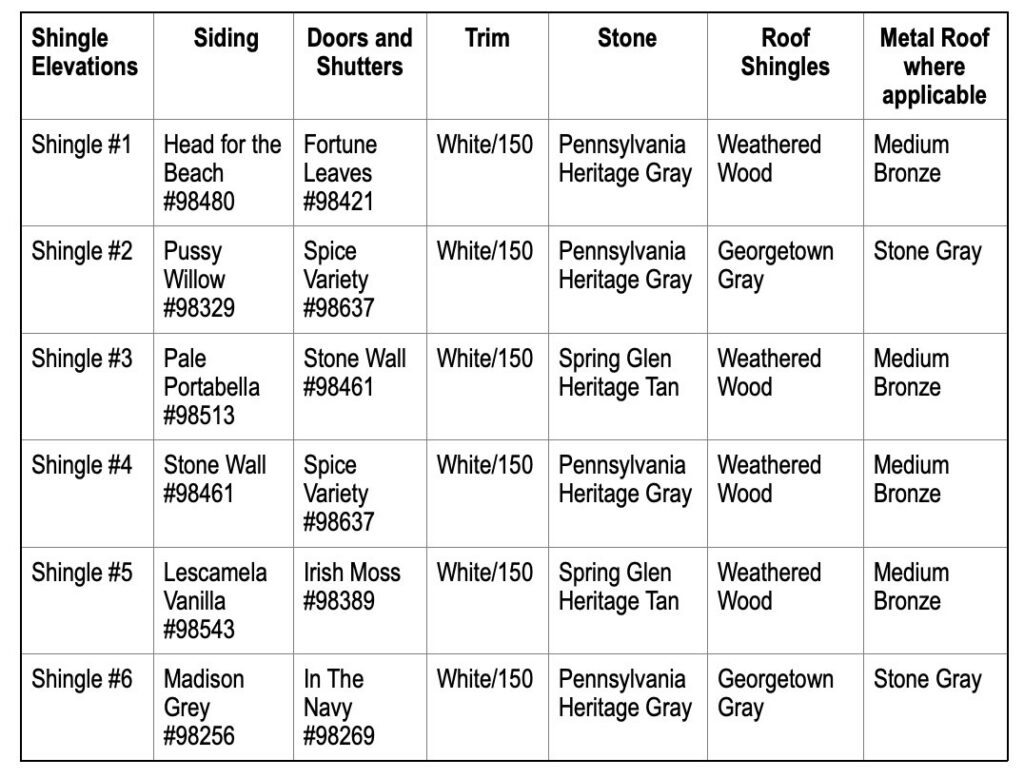
Paint Finishes: All exterior paint finishes should be a semi-gloss finish for the trim and a flat finish for the siding. Any variations are subject to the approval of the DRC.
Disclaimer: These color palettes were provided to the Bayside Community Association by the Builder and may not be inclusive of all color packages used by the Builder.
NV HOMES EXTERIOR COLOR PACKAGES
BAYSIDE – SINGLE FAMILY STANDARD COLOR SCHEMES
(James Hardie ColorPlus Siding) With Stone or Brick
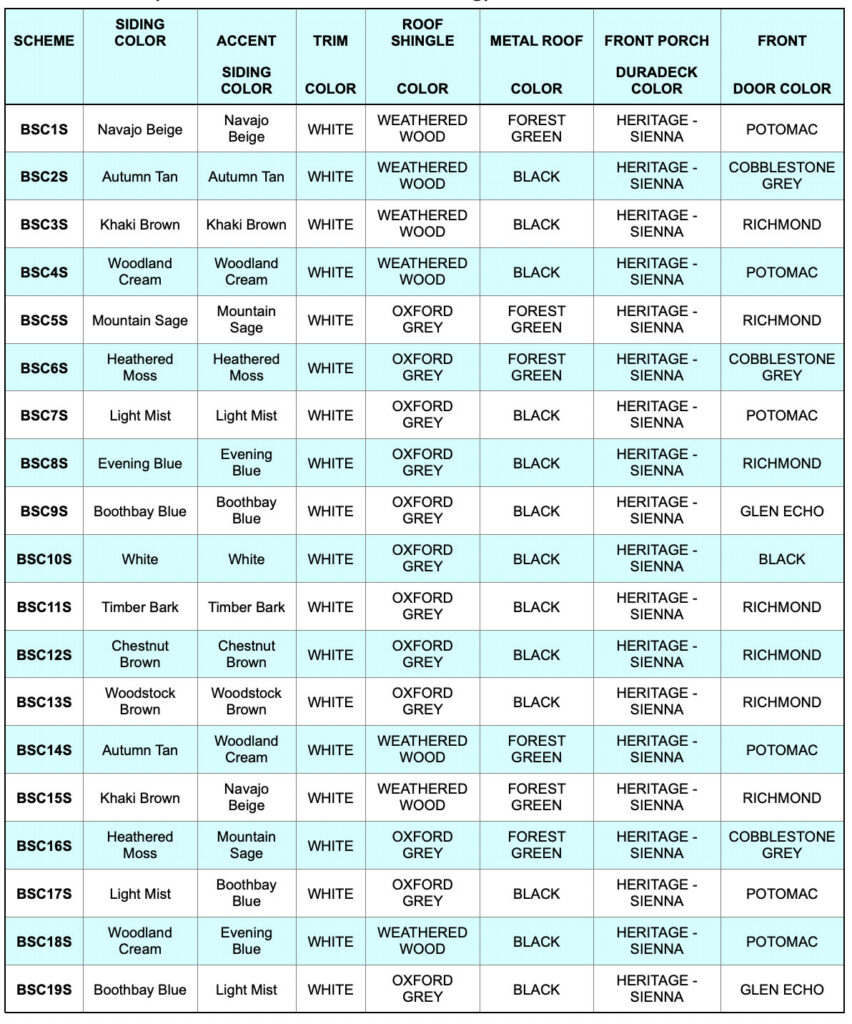
- Roof color is Oxford Grey or Weathered Wood Architectural Shingles
Porch trim, columns, and garage doors to be painted Trim Color
Service and patio doors to be painted trim color
Bay window trim, window fillers, and fypon features directly above or around windows are to be painted “white” to match the windows
Aluminum Soffit/Fascia and Rake material to be Alcoa’s
Mortar color is “Colonial Tan” for Fort McHenry Brick / “Grey” for Blue Ridge Brick
Optional porches shown with “Metal Roof” — see color above
All portico metal roofs to be black.
Paint Finishes: All exterior paint finishes should be a semi-gloss finish for the trim and a flat finish for the siding. Any variations are subject to the approval of the DRC.
Disclaimer: These color palettes were provided to the Bayside Community Association by the Builder and may not be inclusive of all color packages used by the Builder.
KHOV EXTERIOR COLOR PACKAGES
Paint Finishes: All exterior paint finishes should be a semi-gloss finish for the trim and a flat finish for the siding. Any variations are subject to the approval of the DRC.
Disclaimer: These color palettes were provided to the Bayside Community Association by the Builder and may not be inclusive of all color packages used by the Builder.
SCHELL EXTERIOR COLOR PACKAGES
Paint Finishes: All exterior paint finishes should be a semi-gloss finish for the trim and a flat finish for the siding. Any variations are subject to the approval of the DRC.
Disclaimer: These color palettes were provided to the Bayside Community Association by the Builder and may not be inclusive of all color packages used by the Builder.
Paint Finishes: All exterior paint finishes should be a semi-gloss finish for the trim and a flat finish for the siding. Any variations are subject to the approval of the DRC.
Disclaimer: These color palettes were provided to the Bayside Community Association by the Builder and may not be inclusive of all color packages used by the Builder.
SCHELL EXTERIOR COLOR PACKAGES
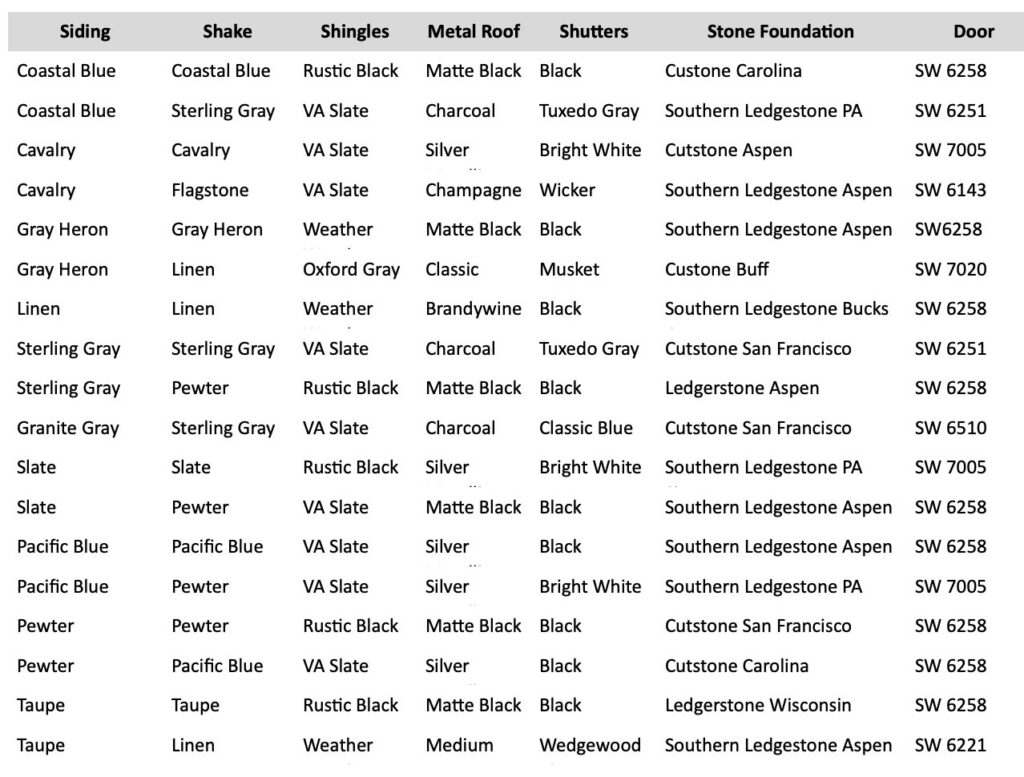
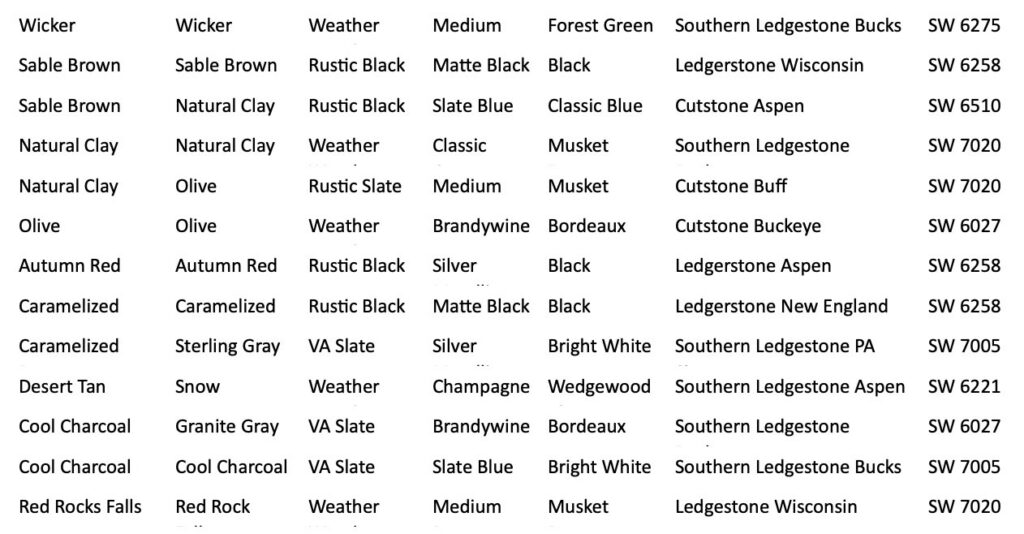
Paint Finishes: All exterior paint finishes should be a semi-gloss finish for the trim and a flat finish for the siding. Any variations are subject to the approval of the DRC.
Disclaimer: These color palettes were provided to the Bayside Community Association by the Builder and may not be inclusive of all color packages used by the Builder.
SCHELL BAYSIDE SIMILAR COLOR RULES
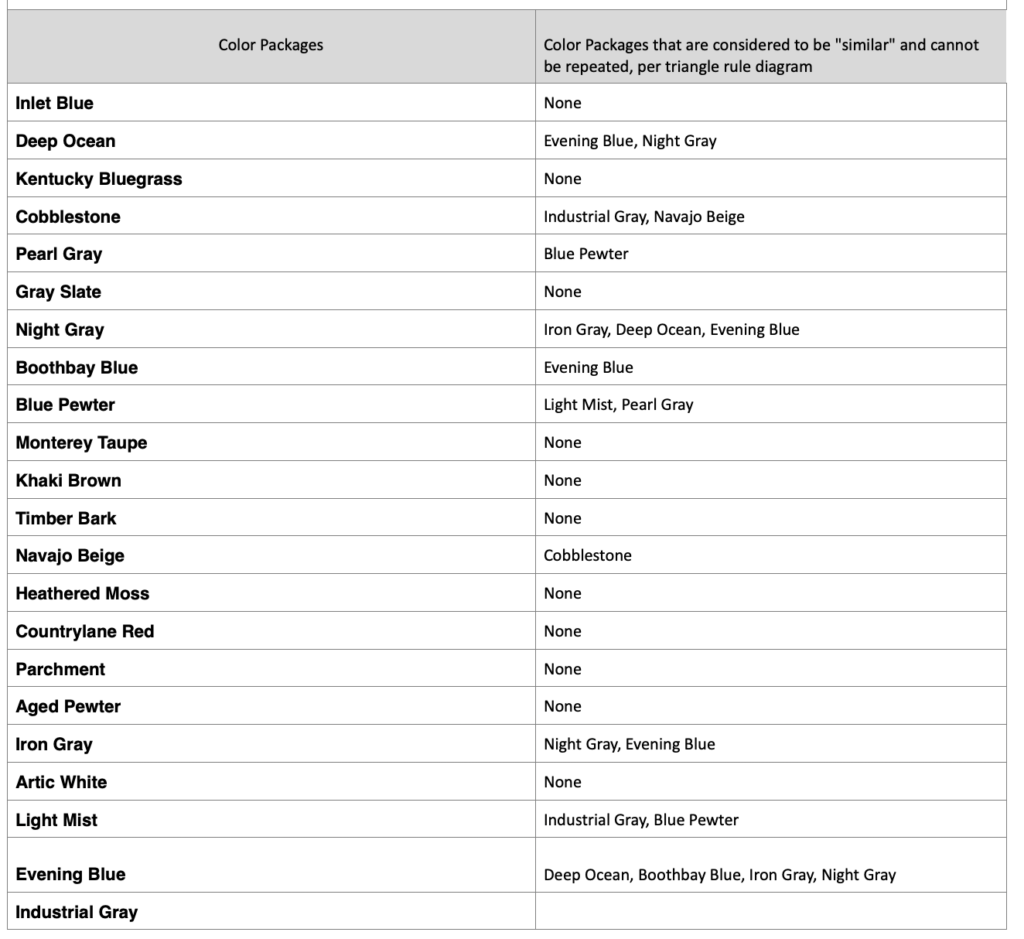
Paint Finishes: All exterior paint finishes should be a semi-gloss finish for the trim and a flat finish for the siding. Any variations are subject to the approval of the DRC.
Disclaimer: These color palettes were provided to the Bayside Community Association by the Builder and may not be inclusive of all color packages used by the Builder.
BEAZER EXTERIOR COLOR PACKAGES
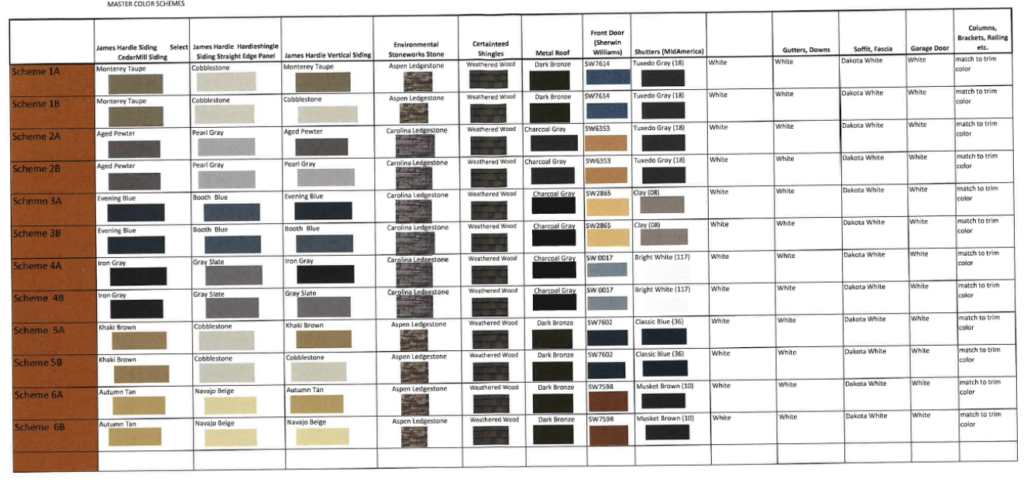
Paint Finishes: All exterior paint finishes should be a semi-gloss finish for the trim and a flat finish for the siding. Any variations are subject to the approval of the DRC.
Disclaimer: These color palettes were provided to the Bayside Community Association by the Builder and may not be inclusive of all color packages used by the Builder.
APPENDIX A-BAYSIDE COMMUNITY PLANT MATERIAL LIST
1. Sheathing: Plywood, particle board, oriented strand board, or other solid material forms the sheathing layer. Attached to the roof rafters or truss system of a home, sheathing is the first line of protection against water intrusion and forms a solid surface for attaching the subsequent roof system layers.
2. Water and Ice Shield: Although not technically a full layer, an ice and water shield (leak barrier or water and ice protector), is a waterproof roof underlayment membrane that functions to protect vulnerable roof areas from ice and water damage. A course of ice and water shield will be installed in roof valleys and along the outside edges of the roof (parallel to the fascia) and in accordance with manufacturer’s specifications under its warranty.
3. Underlayment/deck protection: Quality synthetic underlayment provides a full layer of protection from the elements, including rain, snow, and wind. Synthetic underlayment is superior to felt underlayment in terms of durability, ease of installation, and moisture and mold resistance (some brands have a synthetic that is “breathable” to help with the condensation/moisture that causes mold). Underlayment shall be installed in accordance with manufacturers specifications under its warranty.
4. Flashing/Drip Edges/Pipe Collars: Flashing serves to prevent water intrusion around roof penetrations and to direct water away from critical areas of the roof, for example when the roof plane meets a vertical surface like a wall or a dormer. Visible damaged flashing will be repaired or replaced as needed. Nail holes and seams shall be sealed with a seam sealing material. Where visible, flashing color shall be appropriate for the approved color palette.
Note: If flashing installation requires removal, replacement, and repainting of impacted siding, the homeowner will be responsible for such costs.
New pipe collars shall be installed on all vents, exhausts, or other service stacks that are 4” or less in diameter.
Drip edges, installed at the edge of the roof, serve a vital function by directing water away from the fascia and into the gutter. Without a drip edge, water may end up beneath the shingles and gutters, potentially causing damage to various parts of the home.
5. Asphalt Shingles/Ridge Vent Cap: Five tab-architectural asphalt shingles and color-matched ridge vent cap shingles as appropriate for the geographic location and a minimum 30-year lifetime. Shingles shall be installed to attain a minimum wind rating of 110 mph. Shingle color shall be appropriate for the approved color palette. Ridge- venting, in existing locations, shall be replaced as necessary. Shingles and ridge vents shall be installed in accordance with National Roofing Contractors Association (NRCA) guidelines and the manufacturer’s specifications under its warranty.
6. Gutters and Downspouts: Damaged gutters and downspouts shall be replaced (for those gutters with a leaf-guard or similar system, please see NOTE below). Gutters and downspouts shall be constructed of aluminum and shall be white in color.
NOTE: Gutter protection for leaf/debris of any kind hinders the proper installation of a roof and must be removed and reinstalled by a qualified person which may not be the selected roofing contractor/company. If it is a warrantied product, it must be removed and reinstalled by the company that owns the warranty at the expense of the homeowner.
7. Fascia Boards, Soffits, and Trim: Replace damaged, rotten, or improperly installed Fascia boards, soffits, and other trim.